Enjoying Music Applications with Amiga 500 v1.3 System in 2026

 Over the years I have spent considerable time upgrading all of my Amiga systems, with modern operating systems, hardware upgrades, and new software.

It is wonderful we have such an active Amiga community and scene that supports the ongoing release of new games, new hardware and new Amiga operating system upgrades in 2026.

That said, I also like having a simple Amiga 500 system, running Workbench 1.3 and having the software originally released in that era.
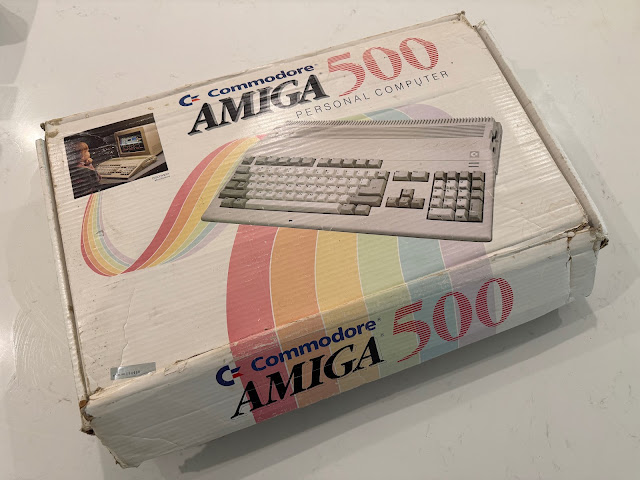
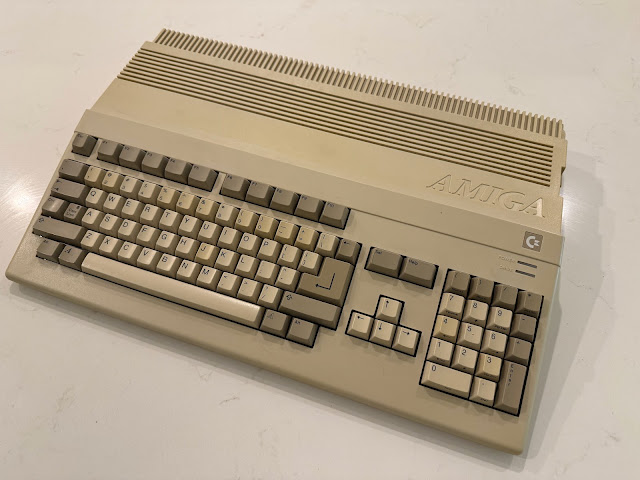
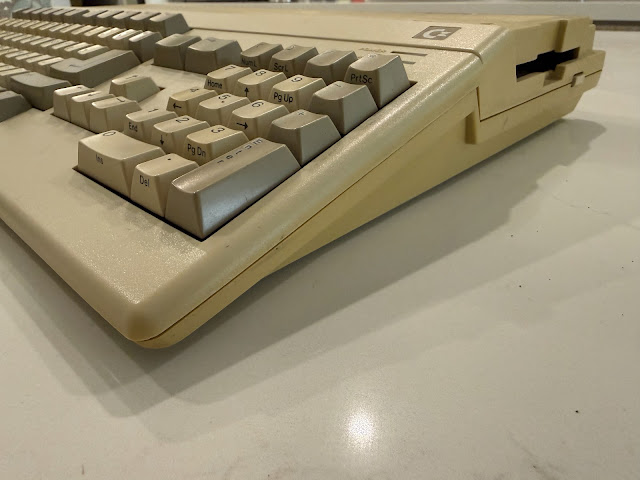
I recently bought this fully tested Amiga 500 second hand, to get a 1MB chip memory system - which was the later Rev 6 Amiga 500 motherboard system.
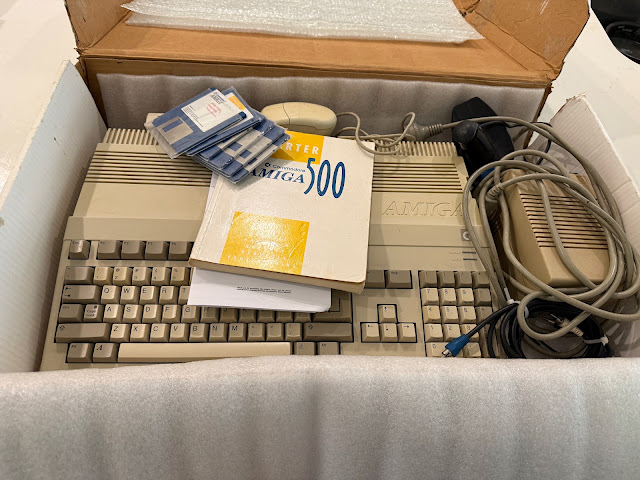
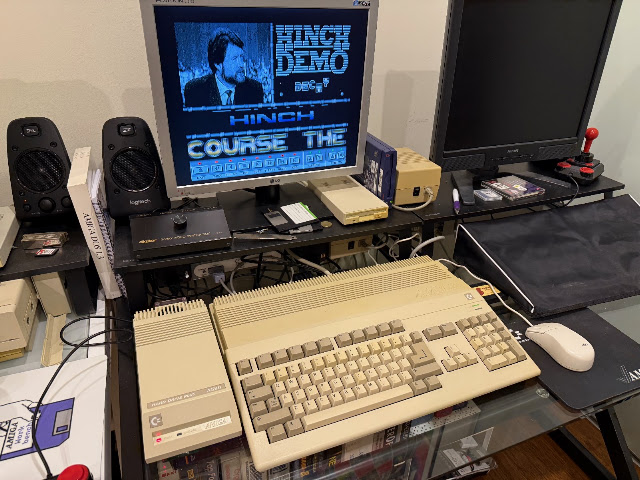
I did this because my previous build A500 system was a 512MB chip machine, which was limiting what software I could play with on it. Most newer games and many applications expect 1MB CHIP memory, or degrade or remove features to work with 512k..
The previous build was an Amiga 500 using a Commodore A590 hard disk expansion, with the hard disk replaced with a SCSI to CF solution. You can read more about it here.
But sadly I didn't do much with it. 
Having the fully upgraded Amiga 500 with ACA500 plus, 030 accelerator, ethernet access, AmigaOS 3.2, next to it made it too easy to just use that instead. Much faster to use ADF files to install, reconfigurable memory, drive, soft kick kickstart switching, CF hard disk swapping for different Workbench versions, way more disk space, easier to transfer large amounts of music, demos and games to it too. 
Essentially, it has none of the older hassles that Amiga 500 ownership usually meant. Makes sense right? After all, that is why we do those upgrades - to make it easier to use.
I decided though that I need one original system, as it was originally released, with the Commodore provided expansion options like the A590 hard disk and A570 CD drive.
Over the past few years, I went to a lot of trouble to source a lot of music (and other) applications that I definitely couldn't afford back in the day. Having the manuals is critical, as many are impossible to use without the manuals.

I spent some time covering some of these applications on my Amiga 4000T, which runs the latest AmigaOS 3.2, ZZ9000 RTG graphics card and hardware ZZ9000AV audio add-on, with USB support, tape drive, CD-burner and lots of other goodies. You can read more about that here.

People these days are generally more focused on getting and playing classic Amiga games rather than the applications on the Amiga.

This is a great shame, as the Amiga had a lot of useful applications released in its Commodore period lifetime. They pushed the boundaries of what a home computer could do.

We all know about the famous Newtek video toaster, but seriously - how many of us actually had the hardware and used it? It was a commercial application, and very few people had it unless they had serious money, an Amiga 2000/3000/4000 and a TV network to produce overlay graphics for. 

The same applied for the high 3D graphics applications for the Amiga like Lightwave, Real 3D, X-CAD, SCALA and more. I never knew anyone who owned or used these when they were originally released. You need a seriously accelerated Amiga to make the most of them. 

Later on in the Amiga's life, Amiga magazines bought the rights to distribute many of these applications on cover disks. So, they finally became affordable for people like me to try them out.

For me, I experienced Amiga applications via graphical and music applications that could run on a humble  Amiga 500, which was my first Amiga. The music applications especially were close to my heart as I love making and listening to music.

Here is me on the family Amiga 500 after school in Perth, back in 1989. No hard disk, everything was on floppy disk.
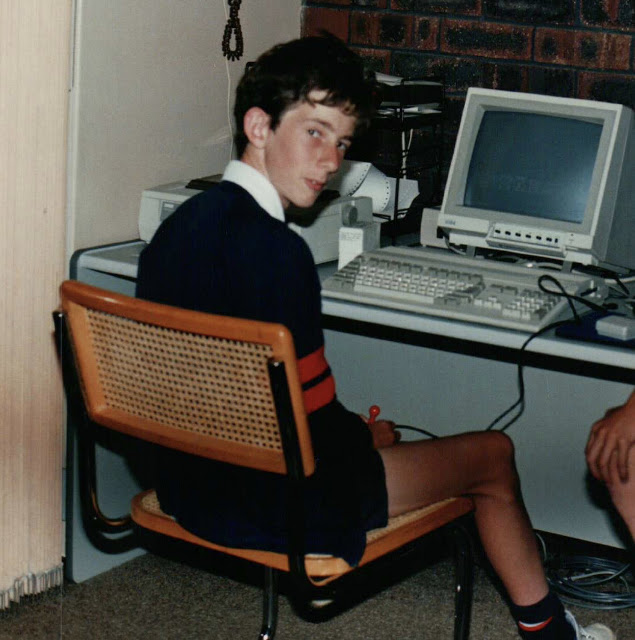
I had multiple friends with Amiga 500's at the time. When I visited them, they had attached hard disk expansions, mountains of floppy disk collections, and I was so envious of them. Money was tight and we didn't have money to buy a hard disk or a mountain of floppy disks for that matter. 

So, I had always wanted a hard disk on the Amiga 500. Ultimately we never did - in 1991 we upgraded to an Amiga 2000HD and then we had a 52MB hard disk!

Ultimately, this is what drove me in recent years to get a Amiga 500 with the hard disk expansion I longed for but never got, the A590. 
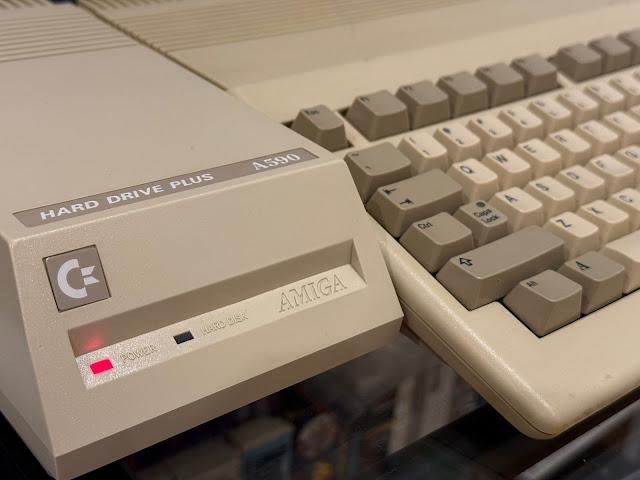
I wanted a period correct Amiga 500 system with the extra bits we couldn't afford to have back then. And now I have it. 
My wife calls it "revenge purchasing" - buying things today that I really wanted, but couldn't afford or missed out on when I was younger. Doing such a purchase and feeling triumph by using it removes a long held desire or frustration from my mind - you could call it removing some long held unhappiness. It feels good! Perhaps you have the same feeling when you buy something you desired for a long time?

Thanks to the Amiga, we got tracker based music composition (Soundtracker/Protracker), excellent MIDI connectivity, and even the Miracle keyboard system and software, to learn how to play Piano on the Amiga!
Music software like Sonix, Deluxe Music 2, Protracker, Bars N Pipes, Music-X, Sequencer One,  TFMX workstation, and so much more. Hardware like GVP DSS Audio sampling, Serial MIDI expansions, and more.

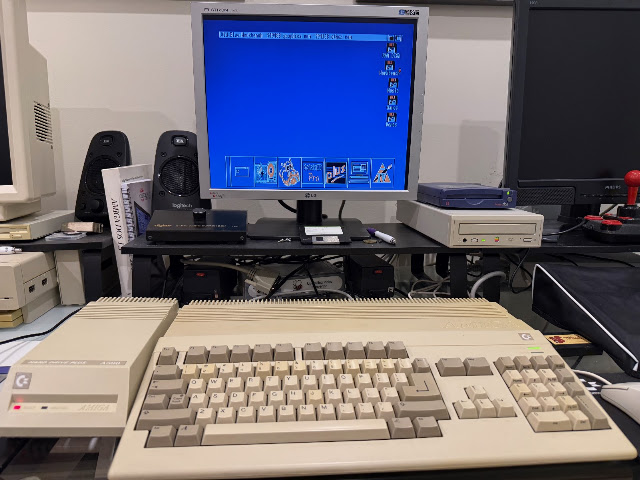
Today I want to shine a light on some of this amazing software for the Amiga, running on a simple Amiga 500 v1.3 machine with 1MB memory, 1MB on the A590 and a 2x512MB CF hard disks in 2026 - no fancy upgrades other than the recently released Old Blue Workbench upgrade for v1.3 on my hard disk.

No AmigaOS 3.2, No WHDLoad. No AGA. No AI slop.

My photos and words here also are the real deal - all mine.  No manipulation - no AI generated shit. In 2026. You are welcome.
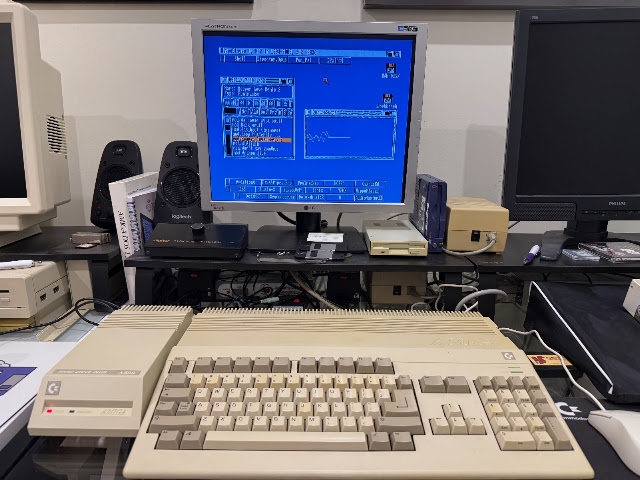
Just great Amiga application software loaded from original floppy disks or installed from floppy disks on the hard disk, as it was back in the day. (FYI the CD and Zip drive in the photo are connected to the A1200 next to the A500)
Amazingly, some of the application software I bought was brand new in box, never removed from the shrink wrap even! What a waste.

In 2026, they have all now been opened by me and used. :-)

Amazingly, in 2026 we still have new 2026 updated Amiga application software that works on Workbench 1.3 Amiga 500 system! 
First, let me show Hippoplayer, a music player for Amiga 1.3 and above. It was released in 1994 at the end of the original Commodore Amiga era, and is still actively updated in 2026! 
It works great on my base Amiga 500 with A590, playing some wonderful classic Amiga tracked module (mod) files. It can play many other formats too!

Easily for me the most interesting music player on the Amiga 500, with small memory footprint and wide module format support includes XM and S3M, amongst many others including MP3! 

I use Hippoplayer on my OS3.x based Amiga systems too (and have done since the 1990's), but unlike most other players for the Amiga that are still updated, it is backwards compatible with Workbench 1.3 still. Long may it continue!

The new 2026 version can even use MHI to playback Mp3's and decode complex S3M music files on the AmiGUS sound card released recently (i covered in a blog entry here). This even works on 1.3 apparently! 
I still plan to try the Workbench 1.3 MP3 support out on my Amiga 3000 in the future, as it has the AMIGus card installed, and it is a superkickstart system that can boot into 1.3 or 3.1.4 environments.
While I was loading up software onto my 1.3 Amiga 500 A590 from floppy disks, I enjoyed some classic Red Sector demos I used to watch in that era also, courtesy of a nearby Amiga 1200/030 system.
You can get better custom mod support with Delitracker (the 1.3 version) - it is the swiss army knife of mod players.

Delitracker supports 45 different mod formats(!), but this program has not been updated in a very long time on Amiga. You can get an old Windows version called Deliplayer also.

Hippoplayer and Delitracker are just music players though.
My dad provided us the first music creation software I used on the Amiga 500 back in 1989, called Sonix 2.0, from Aegis.
This software allowed traditional music composition with limited range of samples of common instruments included, with the ability to connect it to control MIDI devices:

Without a training in music theory, I was all at sea trying to work out how to use this software. 

My late younger brother was getting lessons to learn to play Piano at the time, and we had a Roland Piano and Roland MIDI device connected to it for this. 
This MIDI setup was then connected via MIDI serial port connection to Sonix on the Amiga 500, allowing my brother to save songs he played, and to play them back via the Roland MIDI device and Piano.
MIDI format itself is not using samples stored on the Amiga. The musical score is inputted from the MIDI device in real time and can be edited in Sonix. The notes play the pre-stored instruments stored in the Roland MIDI device (not the Amiga) and playback via the Piano.
You can also create music on Sonix using the small number of included samples with Sonix. This will then playback using the Amiga's audio output, with 4 channel output (2 left and 2 right).
The next music creation software I saw on the Amiga was Quartet by Dan Lennard, which was released as a demo version on an Amiga magazine cover disk.

I managed to track down a boxed copy of the Quartet commercial product in recent years.

Quartet used its own custom music format, and to be honest I found the interface cool looking, but hard to use.

The software only runs from the floppy disk - no hard disk installation is possible.

Songs are presented as 4 channels (2 left, 2 right) horizontally across the screen. You enter notes in each channel, and assign a limited set of available samples for some very Amiga sounding songs!

As I mentioned, the interface looks cool, but a bit hard to use. And the playback locks the screen display, so there is no realtime showing of the audio being played.

After doing some research, I found out that Quartet was released on the Atari ST also, and that version had a different file format to the Amiga version! Example Quartet songs files are mostly written for the ST version from what I can find on the internet.
It was clear to me that I needed to look elsewhere for a music creation tool.
Another Amiga magazine cover disk music application then came my way in the form of Sequencer One. 
This software also allows MIDI control of instruments and recording of input from MIDI devices for editing and playback. It also allows importing of .MID files for playback and editing. 
This Sequencer One software quickly replaced Sonix in our place as it was much easier to configure and use. The MIDI file import function was very welcome indeed - it allowed me to load MIDI files from any source and playback via the Amiga.

These days I have a Roland SC-55 MIDI device to feed the MIDI output from the Amiga 500. 

Actually, I have two Amiga 500 systems, so I was playing around with connecting both to the same SC-55 device since it has two MIDI inputs. It works well! 
Sequencer One had its own file format (.ONE) for songs too, and those could be played back directly on the Amiga internal hardware, or using MIDI output. 
They released a number of sample packs separately, which I managed to locate recently!

In addition to this, there was an upgrade Sequencer One Plus available for those who got the cover disk from Amiga Format. I didn't get it back in the day as I couldn't afford it, but more recently I tracked down a boxed version of the Sequencer One Plus release, which upgrades the cover disk version. 

The Plus upgrade also  removes the MIDI channel restrictions of the cover disk version that stopped me playing back some MIDI files - this is why I wanted to get hold of it!
Sequencer One has multiple views to select from, which allows for music editing how you like it:

Personally, I find Sequencer One a great piece of software for the Amiga for composing music with MIDI.

I used it for over 30 years now for MIDI songs on the Amiga and still find it easy to use in 2026.

Around 1989/1990 I was getting into the demoscene on the Amiga, originally thanks to demo group cracktro productions used on pirated games I got from friends. These cracktros had great music in them, which I found out were called modules. I got other full demo productions from PD libraries and was hooked - especially the music disks from Crusaders with the amazing music of Dr.Awesome!
Tracked music (modules) in the Amiga era were mod files, and consisted of multiple patterns with 64 rows, each with up to 4 channels (2 left and 2 right). You used the keyboard to enter the notes in the order you wanted them played in each channel. Notes were actually small samples of 8-bit audio - the sample size and frequency was deliberately restricted to make the module file sizes small. There were many effects you could do to those notes as they were played too.
It was easy to learn, and the small sample sizes meant you could work off floppy disks. Indeed Soundtracker disks were labelled ST-00, ST-01, etc. 
Tracked modules were heavily used on the Amiga - in games and demos. there is still a strong tracked music scene today. 
The original software made for this was called Ultimate Soundtracker. I never could find a boxed commercial version of this software sadly. I got the software from archive.org to try it out.
There was also the more popular Protracker. I used this software extensively myself when composing the music I ultimately used for the demo group The Experience in the late 1990's. 
I released songs for the demos "T.L.A" in 1997 and "Terminal" in 1998 when I was a university student, both written for Amiga 1200 AGA 030 based machines. 
You can still download the archives from Aminet here! 

The demo "Terminal" is included in the current AmiKit XE distribution if you are using that. I wrote a bit more about The Experience history in my tribute to our late coder and friend Mark here.

Protracker was released as public domain. It was free, and easy to learn how to use.

You could easily manipulate samples to include in your songs. The graphical equalizers over each channel on playback of your latest module creation was addictive to view, but also helped with fixing sound level and balancing issues.

I have spent many many weeks and months using this software to compose songs.

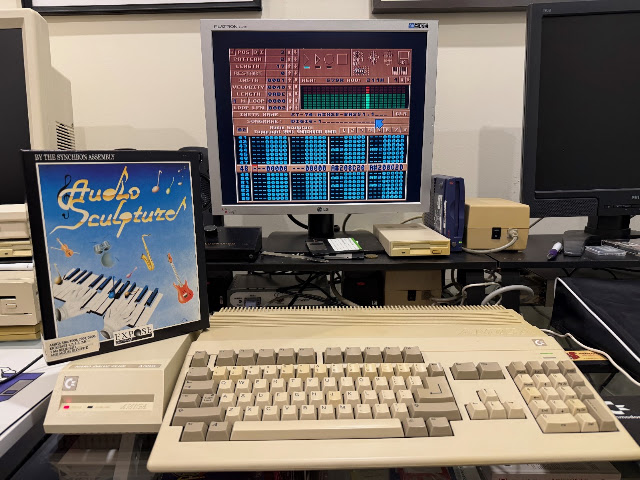
There were also many copycat commercial tracker software releases though, based on the soundtracker/protracker concept. One of these was Audio Sculpture. The interface is very similar - if it ain't broke, why fix it right?
 
As tracker fans will know, soundtracker, noise tracker, and protracker mod file formats were not the only format out there. There were many custom mod formats created too as people explored the Amiga's capabilities more.
Trackers evolved a lot in the 1990's to remove more of the restrictions of mod file formats as hard disk sizes and memory got bigger, which saw the creation of formats like MED, DBM S3M, XM, IT, and more. 
Audio channels support increased with OctaMED and Digibooster Pro to 8 channels on the Amiga. 
OctaMED Professional is great software, and was updated several times, with the commercial SoundStudio V1 the last version released on Amiga. 
Personally I like OctaMED v3, mainly because of the cool intro picture when you start it! Pity they dropped it in later versions.
I got OctaMED from an Amiga magazine cover disk, as did so many people! It is full feature module tracker, with 8 channel support, Sample editing, MIDI support and more:

The pattern editing works as per any other Amiga tracker software, and easy to get to grips with.

There is also a Synth section in OctaMED to create synth based samples yourself.

I also did music creation in IT module format on the PC in the late 1990's/early 2000's, using a piece of software called ImpulseTracker, made by a local Adelaide developer for MS-DOS PC's. This software basically removed all the barriers to channels and sample sizes for module tracking. 
I exported the IT files I created during this time to MP3 also, and made some of the songs available to listen to on Soundcloud - click here if you are interested to listen. 
BTW I don't pretend to be a decent musician - but I had fun making the songs at the time, it was something I wanted to do!
You don't have to sign up to Soundcloud to listen to the songs - just cancel the sign-up and the songs should still play. Well, that worked for me when using a web browser anyway.

An an aside, you can download a modern recreation of ImpulseTracker called Schismtracker for Mac, Linux, Windows, OS/2, Wii and even and older version for AmigaOS 4:

In 2026, thanks to new software on Mac, Windows and Linux like Renoise and physical hardware like the PolyEnd Tracker that I also have, tracking music with modern solutions is also still a thing - just wish I had more free time to do it. A story for another day.
Tracked music, whatever the format,  requires samples. Sound sampling on the Amiga was easy to achieve, as many vendors made sound sampler hardware and software. I have quite a few of them now, used on my various different Amiga systems! 
Probably the most popular (or perhaps well known) is the GVP DSS8 (Digital Sound Studio) sound sampler. I am lucky enough to own a boxed original version of this, with install disks and manual too.
This is a sound sampler that connects to the Parallel port on the Amiga 500, and allows you to record audio in the required IFF audio format needed for trackers like Protracker to work with.

It has two RCA inputs one the back to connect RCA audio leads for left and right channel audio capturing.

For this testing, I used my Sony digital audio player to output audio to the DSS8 sound sampler using a phono to RCA audio cable.

The DSS8 sits nicely next to the MIDI port expansion I have in the serial port next to it on the Amiga 500!

Having loaded on the DSS8 sound sampling software, I could get to work trying it out:

Just go prove this Amiga 500 is a basic 68000 1.3 model, the DSS8 software has a section to advise the system specifications:

This is important to understand since the Amiga can only sample in so much data before it runs out of memory to store it. This also applies to playing module files - the smaller they were the better.

The limitations encouraged creativity to make the most of limited sample sizes. For games, the modules needed to use small memory sizes to leave enough space on disk and in memory for the game itself! Amigas of this era with generally 512k or 1MB maximum memory. Disks stored 880 kilobytes.
There is a good reason tracked music had strict sample size limits - you could only grab a few seconds for each sample. 

The manual is very helpful and shows me how to assign a new sample, and get to work recording it:

There are plenty of customisations you can do in DSS8 software for the sample you are about to capture - levels right and left, monitoring feature to allow you to adjust the settings and sampling rate too:

The screen freezes on purpose when the sound is being captured.

When the capture is done, it prompts for a name for the sample.

Having the sample now on the Amiga, I can modify the sample to my needs. In this case, I wanted a specific section - not the whole thing. The sample editor in DSS8 makes it easy to adjust this.

Having edited it, I saved the sample with a suitable name - this section came from a LoFi song, which suits the lower sampling rate of the Amiga well!

You can see the samples in memory displayed, and you can export them to an IFF audio file on your hard disk.

You can also playback the samples in memory, with many editing functions available too:

There is also a basic tracker built into DSS8 to compose mod files, so you can do sample capturing and song editing in the same DSS8 software!
Audition 4 is another sound sampling software you can use for capturing and editing sound samples on the Amiga.

Since most sound sampler hardware uses the parallel port, the Audition 4 software works with most sound sampling hardware I have here.

The last sound sampler I played with is Aegis's AudioMonster II - I know there is a newer AudioMonster IV software also, but this is the version I was able to find!

I think Audition 4 and AudioMaster II are both excellent sound samplers. DSS8 also works very well - you can't really go wrong with any of them.

Back in the day, Bars N Pipes Professional was a very expensive music creation software package for the Amiga. There is a cheaper Bars N Pipes product which is cut down version of this. I have it also, but I was interested in trying this Professional edition, which I had never used before.

This is a complex piece of software, with multiple tools and functions to learn to compose music in a pipeline, shown graphically from left to right. The left side has the channel number, the sample being used, with the right side is the output, which could be MIDI, or could be internal speaker. 

The manual is essential! You can record and edit MIDI information from external connected MIDI instruments (eg. keyboard) for playback later through your MIDI devices using this software.
Having now used Bars N Pipes Professional, I can really understand more why tracked music (modules) were so popular on the Amiga. This software is intended for more professional music production, where you have a full studio of musical gear with MIDI support, with this software to control the various inputs and outputs. I doubt many home musicians were using this!
The company that made Bars N Pipes Professional also made a home musician version of the software, which was much easier to use, called Super Jam! I have this also, and it is essentially a cut down version of Bars N Pipes:
I also found some older MIDI software for the Amiga that I hadn't seen or heard of before, like MIDI Magic. This was a much simpler MIDI sequencer, lacking most of the features of the more advanced software like Sequencer One, Bars N Pipes, etc.

For those who played Turrican 1,2 or 3, you would be familiar with the very awesome music for those games, written by Chris Huelsbeck.

He chose to create his own TFMX music format, and made his own TFMX Workstation music software to write the songs with! Chris released this software commercially too, although it was in German language only (to my knowledge).  I did manage to secure a boxed copy of TFMX workstation this year!

With the help of Google translate, I can read the German language manual and get the software installed on the Amiga 500 A590 hard disk. It also has a joystick port dongle that needs to be present for the software to work.

It is a bit of mucking around to get it to launch. It needs to be launched as a shell script, as the original software disk is bootable into a shell environment with function keys to launch various versions of the workstation software. It wasn't really intended to run from hard disk.

That said, I got it working eventually on the A590. DOpus was my friend to copy all the files from all the disks and I customised the startup-sequence from the floppy disk to work on a hard disk! :-)

The software included a number of Chris Huelsbeck classic TFMX tunes to get you started.

The TFMX workstation editor resembles a traditional tracker software layout, using patterns, samples and tracks, but with far more channels (8) to play with, and other automation features like Macro support.

As an aside at this point, I was adding these music software I loaded onto the A500 to the dock included with the Old Blue Workbench. However, the icons took up too much space on the desktop. I found a solution by using just the names instead of the icons, and having multiple docks.

This is much better now:

Interestingly enough, one of the more well known music programs I never used until this year - Music-X. I read all about in in Amiga Format magazines back when it was released, but like a lot of software, I couldn't afford it! Now in 2026 I have it though! It says version 1.1 on the box, but it had the 2.0 disks also (I guess the previous owner got an upgrade disk package?) so I used them.

Music-X was considered one the best music editors on the Amiga on its release, with a lot of functionality for MIDI and song creation. It supports more audio channels than tracked music too.

It can operate as a MIDI sequencer, just like Sequencer One Plus, Bars N Pipes or Sonix.

Samples were more flexible too than trackers normally allow. You did need plenty of memory though!

Like the other music software, it can playback internal audio songs created in Music X with samples, or MIDI output.

Another piece of Amiga music software I heard plenty about but never had until now is Dr. T's KCS software:

This interface in Dr. T's KCS 3.5  is very different from Music-X:

For a 1.3 application released well before AmigaOS 3.x, it looks very AmigaOS 3.x in it's look and usage too!

Electronic Arts released a lot of the early Amiga software, games and applications. They committed to the Amiga early on.
An example of this is the Instant Music software, released back in 1986, when the Amiga 1000 was the only Amiga available:

This software uses a what you see is what you get interface where you use the mouse to draw the music you want to play on the timeline editor:

Interesting way to make music, for sure! 

It is limited to a few instruments like Electronic Piano, Organ, Strings and drum kit - so there is only a limited set of songs you can make with it.
Some example tunes are included on disk to listen to also for inspiration.
Electronic Arts didn't stop with Instant Music. Of course, most people  are familiar with Deluxe Paint, the graphics package from Electronic Arts. It was used to make graphics for many Amiga games!
They also released Deluxe Video and Deluxe Music alongside Deluxe Paint and several upgraded versions also were released in the years that followed. 
The second version of Deluxe Music is the version I have:

It has two sets of disks, one set for Workbench 2 and above, and a set for 1.3 machines. I already use this software on my Amiga 3000 under AmigaOS 3.1.4, but I had not used the 1.3 disks before now. Time to install it on my A500.

Like many other music programs I covered here, it fully support MIDI for song creation and editing. It uses a Sonix style music editor interface using traditional sheet music view and editing, but with a lot more functionality available.

While I was hunting around for music applications via Ebay, Facebook and elsewhere too, I came across a title I never heard of called "M".

Just M.

Turns out that M is a very detailed and complex music program that does a lot of music creation tasks in one package - MIDI support naturally, and song composition using the internal audio chip of the Amiga.

I definitely need to read the manual to learn how to use this software - it looks quite involved!

Some other software I never heard of for the Amiga included SIDMON, which allows creation of SID style music - note I stress it is not SID music:

The manual is a tiny pamphlet which contains minimal information - so I wasn't able to get far with it yet. It has the usual pattern song editing method of trackers, with notes, instruments and steps

Another new music software I didn't know about was Drum Studio. Released in a small package with minimal documentation, I wasn't expecting much.

I fired up the example songs to see what it could do. It has a limited set of drum instruments and combination effects to work with, but looks like some small fun if you just want to dabble with creating drum loops for your creations. 

I also got another music program called "The Music Studio" - this was released on Mac also. It shows, as all the information in it is for the Mac release! It supposedly works with MIDI also, with some editing features. Unfortunately the disk didn't work - looking at the state of the label on the disk (which should be white), I was not surprised.

I came across this "The MIDI Music Rave Recording Studio" music package for the Amiga recently, so I picked it up.

As expected, it works well with MIDI equipment connected to the Amiga, with traditional music score editing features like Sonix and Deluxe Music 2. It has a built in Sampler as well.

You can also use a grid view rather than traditional musical score view to see the keyboard inputs from MIDI in real time.

The last Music software I planned to play with here is the Miracle Piano System for Amiga. I saw this advertised in magazines back in the day and very much wanted one. 

Ultimately my father bought me a Yamaha MIDI keyboard for my 18th birthday, which I still have to this day.
I was still interested to try the Miracle Piano system though, which teaches you how to play Piano with an included full keyboard and connection to software controlling it from the Amiga. I got mine shipped from the UK a few years ago now.
I installed the Miracle software onto the A590...and suddenly the power to the unit cut, and wouldn't come back on!
I tried swapping power supplies - but no go. It would not turn on anymore!
I grabbed my ACA500 expansion that I use on the Amiga 1000, and moved the CF card to it so I could complete the setup for Miracle Piano system. I'll have to work out the issue with the A590 later.

With the software installed, I disconnected my MIDI device from the serial port, and connected the Miracle keyboard cable instead. The other end of the cable is connected to the "Miracle port" on the back of the keyboard.

The Miracle Piano software soon launched:

I set up my user profile to get started with the lessons, run on the Amiga.

Time to learn how to play Ode to Joy!

As you press the keys on the Piano, it is shown in the software in real time on the Amiga.

The software on the Amiga detects if you are doing the right thing and quickly let's you know if you don't!

It also plays music on the Piano directly via the serial port connection, much like a MIDI connection would.

Miracle Piano system is an interesting musical software package, and the tight integration between the keyboard and controlling Amiga software is excellent.

You can even do full music performances where the sheet music is displayed in real time on the screen as you play!
As an aside, fortunately I found out the issue with the A590 was just overheating. After it cooled down, I connected it back again and it worked fine. Whew!
It has been an interesting journey exploring the world of Amiga music programs. I hope you found it interesting and perhaps you might try a few of these programs yourself!